What size is this, and how does it compare with the other sizes?
This murti stands 1.1 feet, which is a little over thirteen inches. In practice, it sits between our 1 feet and our larger sizes, and it suits a decorated chowki or a modest makhar in a living room. It is visible across a room during aarti, fits a normal flat without dominating it, and can still be immersed at home in a large tub.
The difference between this and the 1-foot murti is small, a little over an inch, so choose between them on the setup you have rather than on the number. If your chowki or makhar is already bought and sized, pick the one that fits it. Step up to 1.5 feet only for a full makhar setup or a society hall, and down to 10 inches or 8 inches if the murti will sit on a shelf.
The clay, the colors, and the craftsmanship are identical across every size we make.
Which clay is used, and what makes this murti eco-friendly?
It is shaped by hand from shadu mati, the soft riverbed clay traditionally used by murtikars across Maharashtra and Gujarat, and finished with water-soluble, non toxic colors. There is no Plaster of Paris, no chemical paint, no glitter and no synthetic adhesive anywhere on it.
Shadu mati holds fine detail beautifully and breaks down completely in plain water. Because it is natural clay, small variations in shade and surface texture are normal, and each murti carries the marks of the hands that shaped it.
How is a clay murti different from a Plaster of Paris one?
Clay dissolves in water in a matter of hours. Plaster of Paris does not dissolve, and a POP idol can remain largely intact in a water body long after immersion. The paints commonly used on POP idols are chemical enamels rather than natural pigments, which is a separate concern from the material itself.
On the question of rules, many state pollution control boards and municipal bodies in India have moved to restrict or discourage POP idols, and several cities now permit only clay idols at their immersion points. The position varies by state and by city and it changes from year to year, so please check your own municipal corporation's notification for the current season rather than relying on a general answer.
For your puja at home the practical difference is simple. A clay murti this size can be immersed in a tub in your own home. A POP idol of the same size cannot.
Why choose an eco friendly Ganesha at all?
Because visarjan is meant to be a return, not a discard. When the murti is made of shadu mati and coloured with natural pigments, the whole of it goes back into water and soil the way the ritual intends. Nothing is left behind in a lake or a river, and nothing has to be pulled out afterwards.
There is a practical benefit for you as well. An idol that dissolves completely is one you can immerse at home, with your family around you, rather than travelling to an immersion point and handing Ganpati over in a queue. For many households the eco friendly choice is what brought the final aarti back into their own home.
What if there is a hairline crack, or the murti chips?
A fine hairline on a large clay murti is a natural result of drying and is not considered a defect or an ashubh sign. Clay is soft by nature, and small damage while decorating or moving a murti this size is common. Continue your puja as usual and complete the visarjan on the day of your sankalp.
If the murti breaks in a way that makes puja difficult, gather every piece with respect and immerse them together in water, or place them in clean soil. Never put the pieces into household waste.
How do I do the sthapana, and how many days should Ganpati stay?
Clean the space and place a sturdy chowki in the north-east, covered with a fresh red or yellow cloth. Spread akshat, place the murti with both hands, and set a kalash of water with a coconut and mango leaves beside it. Light the diya and agarbatti.
Take your sankalp and say aloud how many days Ganpati will stay. Offer haldi, kumkum, akshat, chandan, durva (21 blades), red flowers, and modak as naivedya, then close with the aarti and a prarthana for kshama. Sthapana is traditionally done in madhyahna kaal, the midday window on Ganesh Chaturthi, though performing it later the same day with full shraddha is entirely acceptable.
Families and workplaces keep Ganpati for dedh din, three, five, seven, or the full ten days ending on Anant Chaturdashi. Any member of the family or team, women included, may perform the sthapana and the daily puja.
Where should the murti be placed, and facing which direction?
Place Ganpati facing north or east, which usually means setting up along the north-east corner - the ishaan kon - of your living room or pooja room. A 1 feet murti on a chowki needs roughly two to two and a half feet of clear width, so plan the corner before the murti arrives.
Keep it raised on a firm, level surface rather than on the floor or a folding table, leave open space in front for the family to sit for aarti, and avoid placing the setup under a staircase or against a wall shared with a bathroom.
Can I do visarjan at home, and how long does it take?
Yes, An 8 inch murti needs a large bucket, a wide tub, or a bathing drum holding roughly 30 to 40 litres of fresh water, so the murti is fully submerged with room to settle. Perform the aarti and the uttar puja, ask Ganpati for kshama for any lapses in seva, and lower the murti gently with both hands. Offer durva, flowers, and a spoon of naivedya into the water as you would at a ghat.
The clay begins softening within the first hour and usually settles over four to eight hours leaving it overnight is easiest. Afterwards, pour the water and soft mitti into a tulsi plant, a garden bed, or large pots on your balcony. Please avoid pouring it into a drain or a kitchen sink.
What makhar and decoration suits a murti this size?
A makhar or backdrop roughly two to two and a half feet wide is right for this height. Much larger and the murti looks lost inside it, much smaller and it feels crowded. Wooden or sturdy cardboard makhars, cloth draped backdrops and paper craft arches all work at this scale.
Keep the materials natural so everything clears without waste. Fresh marigold and mogra strings, banana leaves at the sides, a toran above, cotton or silk drapes, and diyas rather than plastic lighting. Flowers and leaves go straight into your plant soil afterwards, which keeps the whole setup consistent with the murti itself.
What puja samagri will I need?
Durva, red flowers, haldi, kumkum, akshat, chandan, agarbatti and dhoop, a ghee diya, camphor, a kalash with a coconut and mango leaves, supari, panchamrit, and modak or laddoo for daily naivedya, along with a fresh cloth for the chowki.
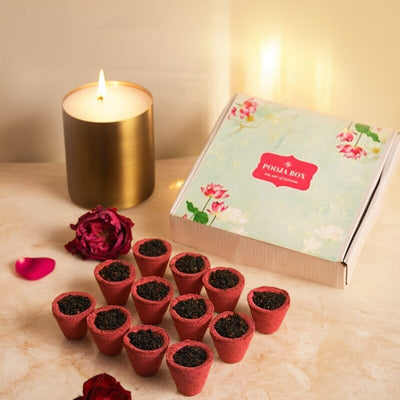
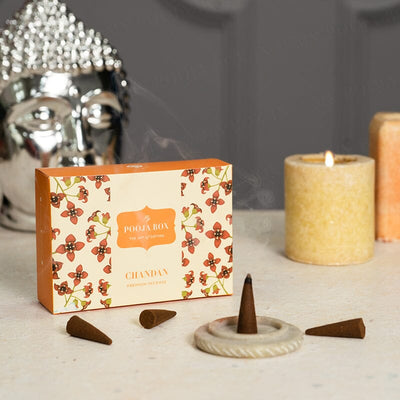
If you would rather not gather everything piece by piece, our Ganesh Chaturthi puja samagri kit has it all measured out for a home puja.
 Healing Crystals
 Pooja Essentials
 Brass Home Decor
 Limited Edition
 Himalayan Salt Lamps
 Pooja Room Decor
 Evil Eye
 Urlis
Urlis
 God Idols











 +91 8010 5888 85
 orders@mypoojabox.com


